
Critical Information
25%Tracks whether the learner found the safety-, diagnosis-, and management-relevant facts that matter most.
AlloPatient
Clinical AI readiness is the ability to use AI in clinical workflows while preserving medical reasoning, patient safety, privacy, patient autonomy, and professional accountability.
Authentic simulation environments designed for medical students, residents, and clinicians.
Reliable performance diagnostics for faculty, hospitals, and researchers.
Context
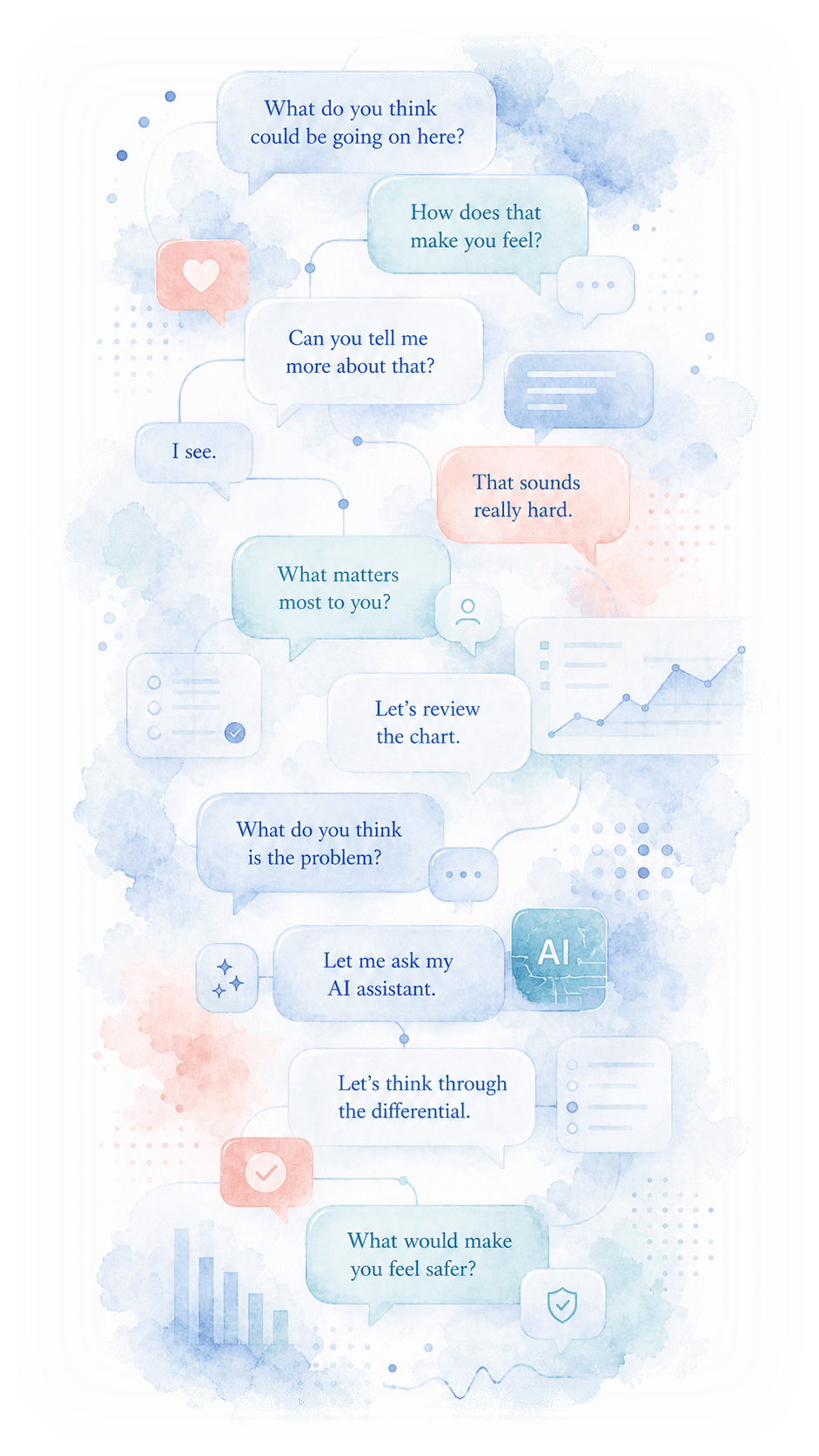
AlloPatient is a simulation-based platform for teaching and assessing clinical AI readiness. It helps medical students practice using AI in realistic clinical workflows while preserving patient privacy, patient autonomy, medical reasoning, safety, and professional accountability.
As AI becomes embedded into documentation, chart review, clinical decision support, patient communication, and administrative workflows, medical trainees need more than casual prompting skills. They need a structured way to learn when AI is appropriate, how to verify it, how to communicate its role, and how to remain accountable for the final clinical judgment.
Learn → Practice → Assess → Diagnose → Improve
Learners complete modules, practice realistic clinical AI scenarios, receive diagnostics, and see whether their AI use improves care or introduces risk.
Clinical AI use is becoming part of real medical work, but medical education has not yet standardized how trainees should be taught or evaluated. AlloPatient gives learners a realistic environment to practice AI-assisted workflows while giving faculty a way to observe judgment, verification, privacy awareness, patient autonomy, and clinical accountability.
Unlike casual ChatGPT vignette practice, AlloPatient is designed around structured clinical tasks, observable workflow signals, outcome quality, and reviewable readiness data. That structure matters for realistic clinical AI workflows where safety, verification, privacy, patient autonomy, and faculty- or research-reviewable performance data all shape whether AI use is clinically appropriate.
Assessment Model
AlloPatient evaluates the full AI-enabled clinical workflow, not just the final answer. During an encounter, the system considers how the learner reviews the chart, questions the patient, uses clinical AI support, handles AI-generated content, revises documentation, rates their confidence, and submits the final note.
Each assessment produces a Clinical AI Readiness Profile across five domains: Critical Information, Safe AI Use, Final Clinical Quality, Efficiency, and Calibration.
Tracks whether the learner found the safety-, diagnosis-, and management-relevant facts that matter most.
Tracks privacy-safe prompts, AI error correction, safety-review responses, disclosure, and clinician accountability.
Tracks whether the final note or answer is clinically accurate, complete, safe, and well documented.
Tracks whether the learner reached a safe answer through focused chart review, questioning, AI use, and revision.
Tracks whether confidence matches performance, rewarding appropriate uncertainty and penalizing overconfidence.
Review
AlloPatient is being developed through iterative review with clinicians, medical educators, and medical trainees. Future versions will incorporate structured feedback on clinical realism, assessment design, usability, and institutional implementation.
This review process is intended to help ensure that AlloPatient scenarios reflect real clinical workflows rather than generic AI-use exercises.